Asian

America

Europe

Africa

Showing posts with label Historical Bulding. Show all posts

USA Cheap Travel : Washington DC National Mall

Nov 27, 2010

One of the tourism places in the United States is Washington DC's National Mall. This is an open area used as a national park, located at the center of Washington, between Independence and Constitution, from the Capitol to the Lincoln meeting room Memoriam. This park is managed by the National Mall and Memorial Parks unit and was actually part of the National Park Service (NPS) or the national parks service in the United States.


This city park is one of the favorite tourist spots, annually receives visitors of approximately 24 million people. This park was established in 1965 and was originally also intended to protect some old parks that previously had to be there and managed by the NPS. One of the historical values of this park is given enough opportunity to commemorate the legacy of the various United States presidents, honor the courage and sacrifice of war veterans.

In addition to historical value, typical of a garden is the shade of tree can give you new of USA holidays. This park has a unique characteristic feature, it is tulips that planted in plots and sorted by color. If we know, tulip is a typical of Dutch flower, but in this garden grows different kinds of tulips, including Greigii, Fosteriana and Kaufmanniana. This Tulip usually blooms from April until the first week of May. So if you have some business travel to USA and plan to visit this park, look for those months so you can celebrate the blooming of tulips and American citizens or other tourists. The complete collection of tulips in the garden, then the area is overgrown with tulips are called libraries.

In addition to the library tulips, there are several other parts of this park that can be visited, including the Constitution Gardens, the old post office tower, a memorial monument or obelisk memorial John Ericsson Gorge Mason. Do not lose too many historical places like the Washington monument, memorial or the Vietnam Veterans fighters Lincoln memorial. Visiting this park, you are guaranteed to be satisfied to see America's past history.

Visit Washington DC National Mall is one kind of USA cheap travel package and last minutes travel because you do not need much money and just need a minutes to put yourself in the park. To get this park, you can use public transportation because it’s strategic location. Do not choose the museum’s café because it’s very expensive and crowded, than you can choose other restaurant in near of the park.

Hungarian Parliament Building

Oct 3, 2010


The next beautiful place in the world is The Hungarian Parliament Building. Yes, this is one historical building in Hungary, also becomes the largest building in that country but on the second places in Europe. This is the seat of the National Assembly of Hungary, one of Europe's oldest legislative buildings, a notable landmark of Hungary and a popular tourist destination of Budapest. It’s located in Lajos Kossuth Square, on the bank of the Danube, in Budapest.


This building was built in 1873 and worked by about one thousand people on its construction. But on 1890, National Assembly resolved to establish a new, representative Parliament Building, expressing the sovereignty of the nation. Nowadays, this building is used for Ethnographical Museum, the other as the Ministry of Agriculture.


One of the famous parts of the building is the hex decagonal (sixteen-sided) central hall, with huge chambers adjoining it: the Lower House (today the National Assembly meets here) and the Upper House (until 1945). The Holy Crown of Hungary, which is also depicted in the coat of arms of Hungary, has been displayed in the central hall since 2000.

Further features include the stained glass and glass mosaic paintings by Miksa Róth.
Due to its extensive surface and its detailed handiwork, the building is almost always under renovation.
During the Communist regime, the government added a large red star to the central steeple at the dome of the building, but after its downfall, the star was removed from the steeple

The Karnak Temple

May 28, 2010

The Karnak Temple Complex is located in Egypt, about 500 km south of Cairo, near the city in Upper (southern) Egypt, Luxor. This temple usually called Karnax, consist of large conglomeration of ruined temples, chapels, pylons and other buildings. This temple was built with massive structure by Pharaoh Ramses II, around 1931 until 1351 BC.

The main part of Karnak is divided into some parts. Precinct of Amun-Re is the largest area that was dedicated to Amun-Re, the chief deity of the Theban Triad and consist of several colossal statues including the figure of Pinedjem I which is 10.5 meters tall.
Then other part, Precinct of Mut Located to the south of the newer Amen-Re complex, this precinct was dedicated to the mother goddess, Mut, who became identified as the wife of Amun-Re in the eighteenth dynasty Theban Triad. It has several smaller temples associated with it and has its own sacred lake, constructed in a crescent shape.

Precinct of Montu is located to the north of the Amun-Re complex and is much smaller in size. It is not open to the public and dedicated to the son of Mut and Amun-Re, Montu, the war-god of the Theban Triad.

Last part is Temple of Amenhotep IV and constructed on the site was located to the east of the main complex, outside the walls of the Amun-Re precinct. It was destroyed immediately after the death of its builder.


An ancient sacred lake is part of the site as well. It is located near Luxor, some 500 km south of Cairo, in Egypt. The area around Karnak was the ancient Egyptian Ipet-isut ("The Most Selected of Places") and the main place of worship of the eighteenth dynasty Theban Triad with the god Amun as its head. It is part of the monumental city of Thebes. The Karnak complex takes its name from the nearby and partly surrounded, modern village of el-Karnak, and some 2.5 km north of Luxor.

The Baalbek

May 23, 2010

One more beautiful historical building in Asian, Baalbek is one of old town that still exist until now. This town is located in the Bekaa Valley, Lebanon. It is famous for its exquisitely detailed yet monumentally scaled temple ruins of the Roman period, when Baalbek, then known as Heliopolis, was one of the largest sanctuaries in the Empire. It is Lebanon's greatest Roman treasure, and it can be counted among the wonders of the ancient world. It contains the largest and most noble Roman temples ever built, and they are among the best preserved.


Baalbek is one of World Heritage Site by UNESCO and become one of tourist object in Lebanon.

Towering high above the Beqaa plain, their monumental proportions proclaimed the power and wealth of Imperial Rome. The gods worshiped here, the Triad of Jupiter, Venus and Bacchus, were grafted onto the indigenous deities of Hadad, Atargatis and a young male god of fertility. Local influences are also seen in the planning and layout of the temples, which vary from the classic Roman design.
Baalbek is home to the annual Baalbeck International Festival. The town is located about 85 km north east of Beirut, and about 75 km north of Damascus. It has a population of approximately 72,000.


mc

The Louvre Museum

May 4, 2010

France has any beautiful places that can attract visitor. Eifel is one of them, and beside the romantic Eiffel, France also has The Louvre museum. This is one of the largest museums in the world and also become a central landmark of Paris, France. The museum is located on the Right Bank of the Seine in the 1st district.


This museum show up any object from 10 August 1973 with an exhibition of 537 paintings. The collection is about 380.000 objects and display 35,000 works of art in eight curatorial departments. The collection from prehistory to the 19th century is exhibited over an area of 60,600 square meters (652,300 square feet).
These all collection consist of Egyptian antiquities, Near Eastern antiquities, Greek, Etruscan, and Roman, Islamic art, Sculpture, Decorative arts, Painting and also Prints and drawings.

Louvre Palace is the house of the museum; this palace was which began as a fortress built in the late 12th century under Philip II. Remnants of the fortress are still visible. The building was extended many times to form the present Louvre Palace.

In 1672, Louis XIV chose the Palace of Versailles for his household, leaving the Louvre primarily as a place to display the royal collection, including, from 1692, a collection of antique sculpture. In 1692, the building was occupied by the Académie des Inscriptions et Belles Lettres and the Académie Royale de Peinture et de Sculpture, which in 1699 held the first of a series of salons. The Académie remained at the Louvre for 100 years. During the French Revolution, the National Assembly decreed that the Louvre should be used as a museum, to display the nation's masterpieces.

The Nabatean city of Petra

Apr 6, 2010

This is one of the wonders of the world; Petra is an archaeological relic in Jordanian. This beautiful place lies between the mountains which form the eastern wing of a large valley of Wadi Aramba, precisely in the lowlands. Petra means rock, a former city that was founded by chiseling the stone walls, exactly in a 40-meter-high rock.


Petra was founded by Nabatean tribe in nine eighteenth dynasty of Egypt by the King Aretas IV as the city that are difficult to be attacked by enemy and secure from natural disasters such as sandstorms. Petra was the capital of the kingdom, which was built with an elaborate irrigation system and a theater that holds 4000 people.


The site remained unknown to the Western world until 1812, when it was introduced by the Swiss explorer Johann Ludwig Burckhardt. It was described as "a rose-red city half as old as time" in a Newdigate prize-winning sonnet by John William Burgon. UNESCO has described it as "one of the most precious cultural properties of man's cultural heritage.

Now, this place is opened for tourist. In 2006 the design of a Visitor Centre began. The Jordan Times reported in December 2006 That 59.000 people visited in the two months October and November 2006, 25% fewer than the Same Period in the previous year.

Mont Saint-Michel

Mar 14, 2010

This is one of beautiful places in France. Mont Saint-Michel is an island that located on the bay, approximately one kilometer off the country’s north coast, at the Couesnon River near Avranches, Normandy, France. This is a historical place in France, because it was used as an Armorican stronghold of Romano-Breton culture and power.
Mont Saint-Michel is a rocky tidal island and that at the beginning was connected to the mainland via a thin natural land bridge, which before modernization was covered at high tide and revealed at low tide. In 1879, the land bridge was fortified into a true causeway. This prevented the tide from scouring the silt round the mount.

In prehistoric times the bay was land. As sea levels rose erosion shaped the coastal landscape over millions of years. Several blocks of granite or granulite emerged in the bay, having resisted the wear and tear of the ocean better than the surrounding rocks. These included Lillemer, the Mont-Dol, Tombelaine (the island just to the north), and Mont Tombe, later called Mont-Saint-Michel.

Now this island becomes one of UNESCO World Heritage Site and was opened for commune tourist object.

The Colossum

Feb 24, 2010


This was Roman inheritance. Colossum is an elliptical amphitheatre in the center of the city of Rome, Italy, the largest ever built in the Roman Empire. It is considered one of the greatest works of Roman architecture and Roman engineering.

Construction of the Colosseum began under the rule of the Emperor Vespasian in around 70–72AD. The Colosseum is an entirely free-standing structure. It derives its basic exterior and interior architecture from that of two Roman theatres back to back. It is elliptical in plan and is 189 meters long and 156 meters wide, with a base area of 24,000 m2. The height of the outer wall is 48 meters. The perimeter originally measured 545 meters. The central arena is an oval long and wide, surrounded by a wall high, above which rose tiers of seating.


Capable of seating 50,000 spectators, the Colosseum was used for gladiatorial contests and public spectacles. As well as the gladiatorial games, other public spectacles were held there, such as mock sea battles, animal hunts, executions, re-enactments of famous battles, and dramas based on Classical mythology. But today Colosseum becomes a major of tourist object and travel destination in Rome. There is now a museum dedicated to Eros located in the upper floor of the outer wall of the building. Part of the arena floor has been re-floored.

Teotihuacan

Feb 9, 2010


Teotihuacan is one of the most noted archaeological attractions in Mexico. Located in San Juan Teotihuacán municipality in the State of México, this place is an enormous archaeological site in the Basin of Mexico, containing some of the largest pyramidal structures built in the pre-Columbian Americas. Apart from the pyramidal structures, Teotihuacan is also known for its large residential complexes, the Avenue of the Dead, and numerous colorful, well-preserved murals.

The name Teōtīhuacān was given by the Nahuatl-speaking Aztec centuries after the fall of the city. At its zenith in the first half of the 1st millennium CE, Teotihuacan was the largest city in the pre-Columbian Americas. At this time it may have had more than 200,000 inhabitants, placing it among the largest cities of the world in this period. The civilization and cultural complex associated with the site is also referred to as Teotihuacan or Teotihuacano.

Although it is a subject of debate whether Teotihuacan was the center of a state empire, its influence throughout Mesoamerica is well documented; evidence of Teotihuacano presence, if not outright political and economic control, can be seen at numerous sites in Veracruz and the Maya region. The ethnicity of the inhabitants of Teotihuacan is also a subject of debate. Possible candidates are the Nahua, Otomi or Totonac ethnic groups. Scholars have also suggested that Teotihuacan was a multiethnic state.

As a city, Teotihuacan has a multi-ethnic city, with distinct quarters occupied by Otomi, Zapotec, Mixtec, Maya and Nahua peoples. The religion of Teotihuacan was similar to those of other Mesoamerican cultures. Many of the same gods were worshiped, including the Feathered Serpent (the Aztecs' Quetzalcoatl) and Rain God (the Aztecs' Tlaloc.)The dominant civic architecture is the pyramid. Politics were based on the state religion; religious leaders were the political leaders.
Site Layout is consisting of many parts. The city's broad central avenue, called "Avenue of the Dead" (a translation from its Nahuatl name Miccoatli), is flanked by impressive ceremonial architecture, including the immense Pyramid of the Sun (second largest in the New World after the Great Pyramid of Cholula) and the Pyramid of the Moon

Further down the Avenue of the Dead is the area known as the Citadel, containing the ruined Temple of the Feathered Serpent. This area was a large plaza surrounded by temples that formed the religious and political center of the city.

Now, the site was designated a UNESCO World Heritage Site in 1987 and became one of. Tourist destination in Mexico, especially for archaeological sites.

The Potala Palace

Feb 6, 2010

The Potala Palace is one of the travel destinations in china. This beautiful place is located in Lhasa, Tibet Autonomous Region, China and was the chief residence of the Dalai Lama Dalai Lama until the 14th Dalai Lama fled to Dharamsala, India, after an invasion and failed uprising in 1959. Until now, this place has renovated and has been converted into a museum by the Chinese.


Located in top of mount Potala, this building consist of three main hills of Lhasa represent the "Three Protectors of Tibet." Chokpori, just to the south of the Potala, is the soul-mountain (bla-ri) of Vajrapani, Pongwari that of Manjushri, and Marpori, the hill on which the Potala stands, represents Chenresig or Avalokiteshvara.

Potala Palace was built by King Songtsen Gampo in 637. This bulding was dedicated for his bride Princess Wen Cheng of the Tang Dynasty of China and used for meditation. In 1645, the fifth Dalai Lama, Lozang Gyatso after one of his spiritual advisers start the construction of Potala Palace and finished on 1694. From that time, this place was used as winter place by Dalai Lama.

Some of the biggest parts of this building are White Palace Portrang Karpo, Red Palace, Great West hall, The Saint’s Chapel, North Chapel, and also The Lhasa Zhol Pillar.

And now to protect this historical place, The Potala Place now is one of UNESCO World Heritage Site


Abu Simbel

Jan 18, 2010

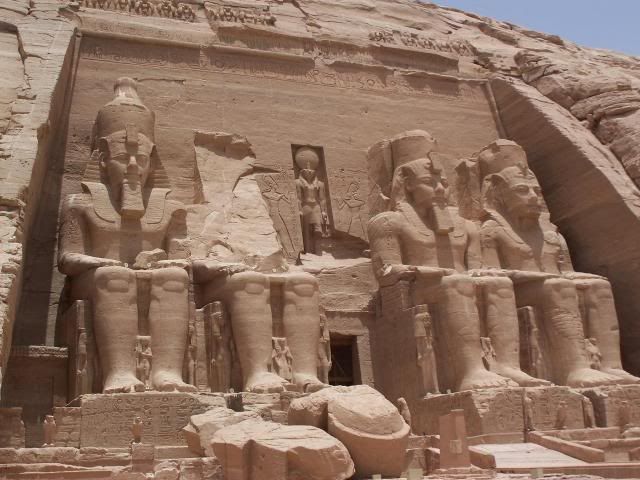
One of Egypt’s miracle beside pyramid and spinx, there is Abu Simble. Abu Simbel is archaeological site comprising two massive rock temples. Located in Nubia, southern Egypt on the western bank of Lake Nasser about 290 km southwest of Aswan.

This site formed as twin temples that contain of many statues that patched on the side of temples and also on the pillar. These temple were carved out of the mountainside during the reign of Pharaoh Ramesses II in the 13th century BC, as a lasting monument to himself and his queen Nefertari, to commemorate his alleged victory at the Battle of Kadesh, and to intimidate his Nubian neighbors. However, the complex was relocated in its entirety in the 1960s, on an artificial hill made from a domed structure, high above the Aswan High Dam reservoir.


The relocation of the temples was necessary to avoid their being submerged during the creation of Lake Nasser, the massive artificial water reservoir formed after the building of the Aswan High Dam on the Nile River. Abu Simbel remains one of Egypt's top tourist attractions.
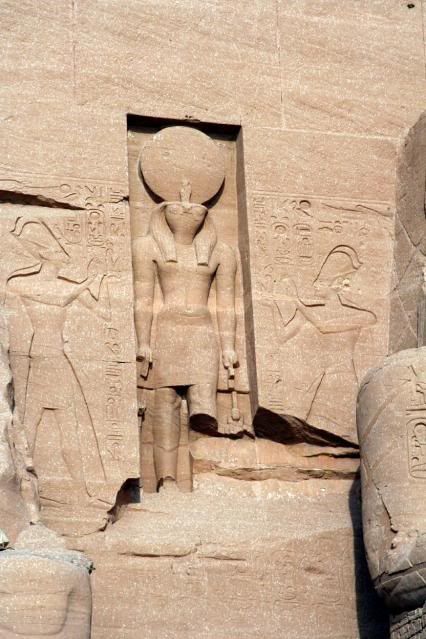
There are two kind of temples. The Great temple and other small temple. The great temple was built and dedicated to the gods Amun, Ra-Horakhty, and Ptah. There are colossal statues with Ramesses II face . these statues were sculpture directly from the rock . All statues represent Ramesses II, seated on a throne and wearing the double crown of Upper and Lower Egypt.


The small temples was also called as The temple of Hathor and Nefertari, was built about one hundred meters northeast of the temple of Ramesses II and was dedicated to the goddess Hathor and Ramesses II's chief consort, Nefertari. the statues, slightly more than ten meters high, are of the king and his queen. On the other side of the portal are two statues of the king, wearing the white crown of Upper Egypt and the double crown . these are flanked by statues of the queen and the king. What is truly surprising is that for the only time in Egyptian art, the statues of the king and his consort are equal in size.

Saint Basil's Cathedral

Dec 22, 2009

This place popularly known as the Cathedral of Basil the Blessed, located in Red Square, Moscow. This Cathedral was built on 1555-1561, on the order of Ivan IV of Russia to commemorate the capture of Kazan and Astrakhan, it marks the geometric center of the city and the hub of its growth since the 14th century.

Trinity Church or Trinity Cathedral is the name of original building of this Cathedral, which is contained of eight side churches arranged around the ninth, central church of Intercession; the tenth church was erected in 1588 over the grave of venerated local Fool Vasily. The building's design, shaped as a flame of a bonfire rising into the sky, its looks like the building in Aladdin animation movies.

From 1583, this building was renovated several times, so the condition of the building well maintained and stay colorful. The cathedral has operated as a division of the State Historical Museum since 1928. It was completely secularized in 1929 and, as of 2009, remains a federal property of the Russian Federation. The cathedral has been part of the Moscow Kremlin and Red Square UNESCO World Heritage Site since 1990.


The Pagan Pagoda, Myanmar

Nov 26, 2009


Located about 425 mil or 680 km in north of Yangon, Myanmar. Pagan pagoda is a religious place which contains more than 2000 temples, pagoda and stupas. This building built and decorated by master craftsmen in 11-13 AD.

Today, the remains of more than 2,000 of Pagan’s pagodas and temples form the greatest assemblage of Buddhist monuments in the world. Pagan is a religious and archaeological marvel, and some would say it’s “a wonder of the ancient World.” The temples stretch for eight miles along the bank of the Ayeyarwady River and for about two miles inland. At some points the ruins are so dense that it’s often described as a place where it’s impossible to move without touching something sacred.


(any source)


The Inca City of Machu Picchu

Nov 21, 2009

Here's one of the most beautiful places in the world. Machu Picchu is a relic of the Incas that the remnants of the building. This site is one of the most recognized symbol of the tribe Inca and is often called the lost city of the Inca Empire


Located in the back of Urubamba in the Peruvian mountains, the site became one of UNESCO world heritage site in 1983. This heritage building built in the classical style of Inca era. The main building of Intihuatana, Temple of the Sun, and Space Three Windows.


On 7 July 2007, Machu Picchu was selected as one of the wonders of the world.